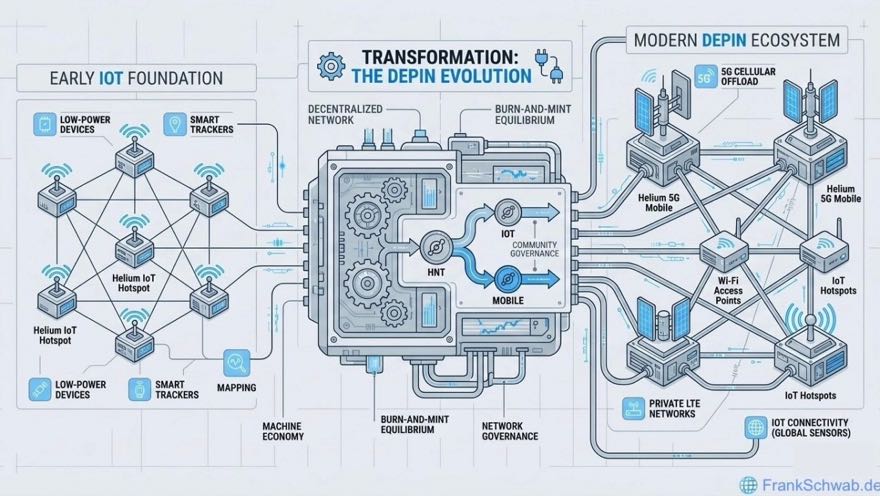
When most business leaders hear the word "crypto," the mind immediately drifts to volatile digital currencies, speculative trading, or shifting regulatory frameworks. But away from the daily market headlines, a far more profound structural shift is occurring at the intersection of physical infrastructure and decentralized consensus.
It is called DePIN (Decentralized Physical Infrastructure Networks), and it is fundamentally altering how global telecom, data storage, and compute networks are built, funded, and scaled. If you understand how Uber or Airbnb leveraged underutilized real-world assets, you already understand DePIN. It is the natural corporate evolution toward a hyper-scalable, asset-light physical footprint.
The Capital-Intensive Bottleneck of Traditional Infrastructure
Building physical networks is a brutal, capital-intensive game. Historically, a traditional telecommunications carrier or a centralized cloud provider had to commit billions of dollars in upfront capital expenditure (CapEx) to lay fiber, erect macro-cell towers, or build warehouse-sized data centers.
Worse yet, infrastructure demands are scaling exponentially. The explosive rise of generative AI, high-capacity autonomous fleets, and specialized IoT applications means centralized networks are hitting structural limits. They simply cannot deploy physical hardware fast enough or cost-effectively enough to satisfy the sheer volume of global data traffic.
Crowdsourced Hardware as the Ultimate Asset-Light Strategy
DePIN solves this structural constraint by flipping the traditional infrastructure financing model completely on its head. Instead of a single corporation taking on massive balance sheet debt to build a network, a decentralized protocol crowdsources existing, underutilized hardware from independent operators all over the globe.
The network coordinates these global participants by rewarding them programmatically with cryptographic tokens that represent a direct, fractional stake in the system's future capacity. By shifting the initial CapEx burden to the crowd, the network can deploy globally at a speed and cost that no traditional centralized enterprise can match.
Enterprise Proof of Concept: The Telecom Offload Transformation
To see this model moving out of the sandbox and into corporate reality, look no further than the wireless space. The Helium Network has undergone a massive structural shift from its early days as a niche IoT tracking project into an institutional-grade telecom utility:
- Commercial Offloading: Major carriers are now actively routing real consumer smartphone traffic onto Helium’s local, decentralized Wi-Fi and small-cell infrastructure to relieve dense urban network congestion.
- The Data Credit Loop: This is no longer an ecosystem fueled by speculative token emissions. Network utilization is priced uniformly in dollar-pegged Data Credits ($0.50 per Gigabyte). When a carrier routes data through a community node, it requires a programmatic, permanent burn of the native token—directly tying token scarcity to real-world commercial traffic.
- Proven Capacity: The network now processes thousands of terabytes of data per quarter, proving that decentralized networks can meet the rigorous uptime and service requirements of multi-billion-dollar enterprise clients.
Three Structural Shifts for Institutional Allocators
For forward-thinking corporate allocators, strategic advisors, and board members, DePIN demands attention because it changes three fundamental business rules:
- Drastic Operating Cost Reduction: By eliminating administrative corporate layers and leveraging decentralized hardware, these protocols can deliver high-performance compute, data storage, and network routing at a fraction of standard legacy market rates.
- Settle Layers for Autonomous Systems: As we transition deeper into the Machine Economy, machines will need to autonomously transact with other machines. DePIN provides the non-custodial, transparent settlement layers necessary for connected EV chargers, autonomous drones, and smart logistics systems to trade data and energy without friction.
- A New Paradigm for Yield Generation: For investors, infrastructure-backed digital assets introduce a highly predictable yield framework—one tied strictly to physical network usage and global data consumption rather than speculative trading volume.
The Next Frontier of Physical Capital
The experimental phase of digital assets is rapidly maturing. The winners of the next decade will not be the networks built on empty promises or financial circularity, but the ones that leverage decentralized coordination to solve genuine physical supply constraints.
DePIN is moving past the hype and establishing a model where physical utility drives sustainable cash flow. The Machine Economy is no longer a futuristic concept—it is actively being deployed, node by node, across the globe.