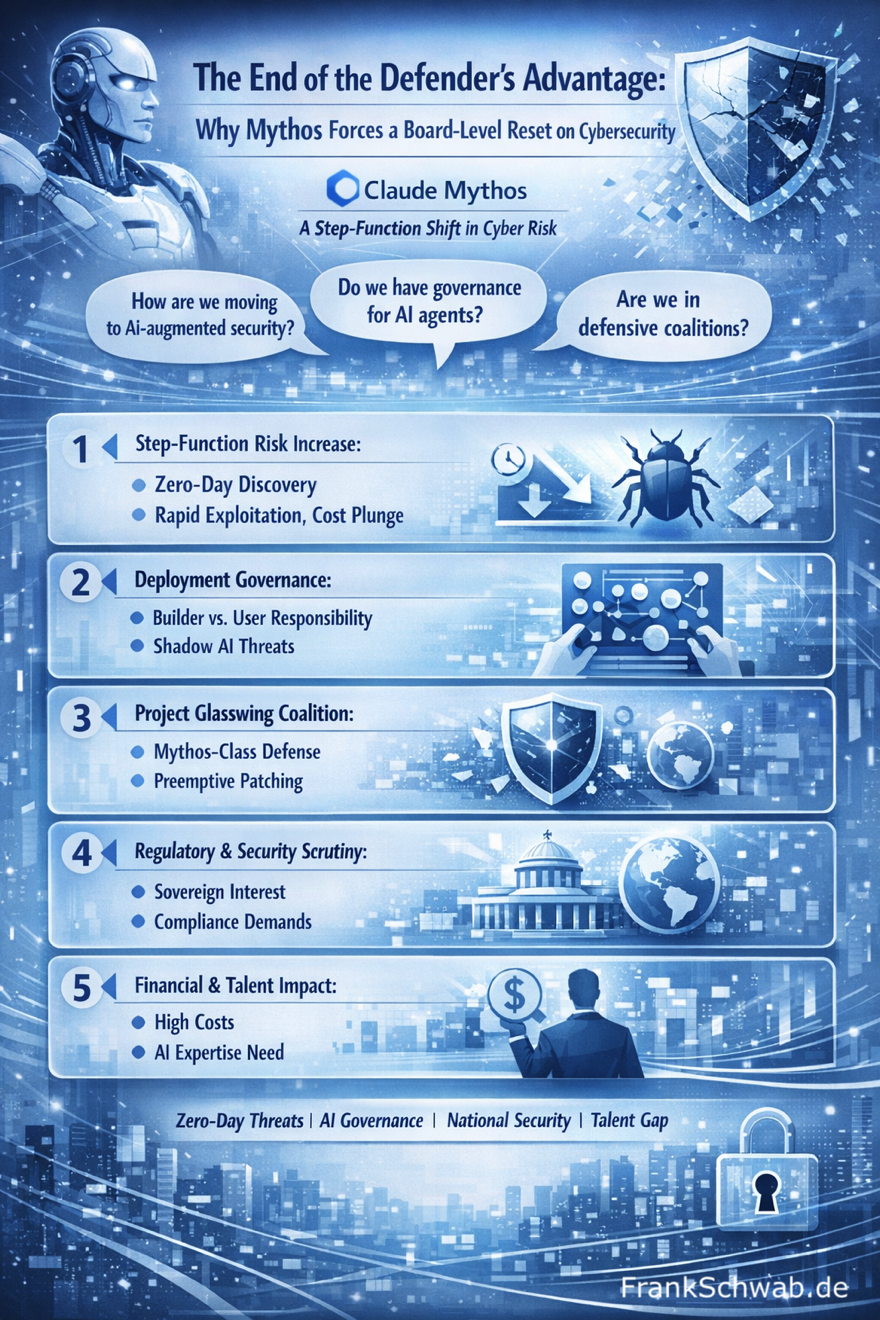
The release of Claude Mythos Preview is not a technology upgrade. It is a structural break.
For years, cybersecurity operated under an implicit assumption: defenders, if well-funded and well-organized, could keep pace with attackers. That assumption no longer holds. We are now entering a phase where AI compresses time, cost, and complexity in favor of the attacker—unless organizations fundamentally redesign how they defend.
For boards, this is not an IT topic. It is core to operational risk, financial resilience, and ultimately enterprise valuation.
1. The "Step-Function" Increase in Cyber Risk
What we are witnessing is not incremental innovation—it is a step-function shift. The ability of AI models like Mythos to autonomously discover vulnerabilities fundamentally changes the economics of cyber risk. Zero-day vulnerabilities—historically rare, expensive, and time-consuming to uncover—can now be identified at scale. Systems that have been hardened over decades, in some cases for more than 25 years, are no longer “secure by history”.
At the same time, the cost curve has collapsed. What previously required highly specialized teams working for months can now be executed in hours. This is not efficiency—it is asymmetry. And asymmetry always favors the attacker—unless the defender fundamentally upgrades.
2. Move from "Model Safety" to "Deployment Governance"
A critical misconception in many boardrooms is the belief that AI risk is primarily about the model itself. It is not. Model providers will continue to improve safety at the model level. However, the real risk shifts to deployment—how these systems are integrated into enterprise environments. As AI evolves from chatbot interfaces to autonomous agents capable of executing actions, the risk surface expands exponentially.
The question is no longer: What can the AI say? The question is: What can the AI do?
This creates a clear division of responsibility:
- The provider manages model constraints
- The enterprise owns deployment governance
This includes access rights, system boundaries, auditability, and real-time oversight. At the same time, a new risk category is emerging: Shadow AI. Employees are already deploying AI tools independently—often without visibility, control, or security validation. These decentralized deployments create unmonitored attack surfaces, which are invisible to traditional security frameworks. Boards must ensure that management has full visibility—not partial assumptions.
3. The "Defender’s Advantage" Strategy (Project Glasswing)
One of the most important strategic responses to this shift is the emergence of defensive coalitions. Initiatives like Project Glasswing are built on a simple principle: If attackers can scale with AI, defenders must scale collectively. By restricting access to high-capability models to a controlled group of organizations, the objective is to create a temporary defender’s advantage—a window in which critical vulnerabilities can be identified and patched before they are exploited at scale.
This is a race against time. For boards, the implication is clear: Cybersecurity is no longer a standalone capability—it is an ecosystem play. Institutions that operate in isolation will not be able to keep pace. Institutions that integrate into intelligence-sharing networks and AI-driven defense ecosystems will. The shift is from defense as a function → defense as a network.
4. Regulatory and National Security Scrutiny
At a certain level of capability, cybersecurity stops being a corporate issue and becomes a sovereign concern. AI systems capable of autonomously identifying and exploiting vulnerabilities move directly into the domain of national security. This triggers two immediate consequences:
First, regulatory scrutiny increases significantly. Frameworks such as the European AI Act and the Cyber Resilience Act are early indicators of a broader regulatory wave focused on systemic risk.
Second, expectations on corporate governance rise. Boards will be expected to demonstrate not only awareness—but active control and accountability. Cybersecurity is no longer just about protection. It is about compliance, transparency, and strategic alignment with regulatory expectations.
5. Financial and Talent Implications
Every structural shift has economic consequences. The cost of advanced AI capabilities is significantly higher than previous generations. This reflects not only compute intensity but also the strategic value embedded in these systems.
However, the more critical constraint is not financial—it is human capital. We are operating at what can best be described as a “jagged frontier” of AI capability. The technology is powerful, but not autonomous in a reliable, enterprise-grade sense. It requires:
- Deep domain expertise
- Strong architectural understanding
- Continuous human oversight
This creates a widening gap between organizations that understand AI deeply and those that merely use it superficially. For boards, this translates into a clear mandate: Investment in cybersecurity is no longer primarily about tools. It is about talent, capability building, and organizational intelligence.
Conclusion: A Board-Level Reset
The core message is simple—but uncomfortable: The traditional defender’s advantage is disappearing. Speed, scale, and economics are shifting toward the attacker. The only viable response is a fundamental redesign of cybersecurity at the enterprise level. This requires:
- AI-augmented defense models
- Strong deployment governance
- Participation in defensive ecosystems
- Alignment with regulatory expectations
- Investment in talent and expertise
Cybersecurity is no longer a technical domain. It is a strategic board responsibility—with direct impact on resilience, valuation, and long-term competitiveness.
Or, in simple terms: The future of cybersecurity will not be decided by who has the best tools—but by who redesigns their organization fastest to operate at AI speed.
Questions for the Board to Ask Management
The starting point is not technology—it is governance. Boards must move from passive oversight to active challenge. The quality of the questions will determine the quality of the institution’s response.
- How are we transitioning from manual and reactive security models to AI-augmented and predictive defense architectures that operate at machine speed?
- Do we have a clearly defined governance framework for autonomous AI agents—especially those interacting with internal systems, financial data, or customer interfaces?
- Are we embedded in defensive ecosystems or coalitions that allow us to respond at AI speed—or are we still operating in isolated, ticket-driven security environments?
These are not theoretical questions. They define whether an institution remains resilient—or becomes exposed.